Product news
This is where we share new flickollect features, improvements, and important service updates.
New to flickollect? Start with the features overview or the demo collection. Find instructions and access conditions in the FAQ.
18.11.2026
The Silent Comedies of Hollywood closes our silent cinema series
Where should a newcomer to silent cinema begin? In The Silent Comedies of Hollywood, a collector makes the case for starting with comedy. Charlie Chaplin turns two bread rolls into a pair of dancing shoes, Buster Keaton plays a whole baseball game alone in an empty stadium, and Harold Lloyd hangs from the hand of a clock high above the street.
Short films by Chaplin and Keaton share the bill with The Gold Rush and The General. Stan Laurel and Oliver Hardy get the last laugh as they try to sell a Christmas tree in Big Business. This essay brings our silent cinema series to a close. You can find the whole series in the film essay catalogue.
12.11.2026
New film essay: Silent Cinema Without Borders
A new illustrated essay, Silent Cinema Without Borders, explores films from France, Sweden, the United Kingdom, Japan and China. From the historical scale of Napoléon and the close-ups of The Passion of Joan of Arc to Buñuel’s surrealism, Ozu’s family stories and The Goddess, it introduces the variety of themes and visual expression in silent cinema across different countries.
A dedicated section features Luis Buñuel, Alfred Hitchcock and Yasujirō Ozu, whose careers began in this era and continued for decades. Collection screenshots can be opened in full screen. The essay is available in English and Russian, and the film essay catalogue now lets you browse by country.
11.11.2026
New film essay: Born of Revolution
A new illustrated essay, Born of Revolution, explores Soviet cinema of the 1920s and its transition to sound. The journey leads from the revolutionary epics of Eisenstein and Pudovkin to Vertov’s experiments, Dovzhenko’s poetry, private life in Bed and Sofa, and Protazanov’s films for a popular audience. Road to Life brings the journey to its close.
A dedicated chapter introduces Sergei Eisenstein, Dziga Vertov and Nikolai Batalov’s screen characters. Collection screenshots let you explore posters, characters and film stills in full screen. The essay is available in English and Russian, and the film essay catalogue now includes a Soviet cinema category.
10.11.2026
Important update: a backdrop editor for film pages
Turn a film frame into a backdrop directly in flickollect — without external graphics software or image-generation fees.
It is great when TMDB already has a backdrop that suits your film perfectly. You can also make one yourself in a graphics editor or with an AI tool. But what if the available images do not fit, and you would rather avoid spending time on other tools or paying for image generation? Our new backdrop editor gives you a simple way to make the film page look the way you want.
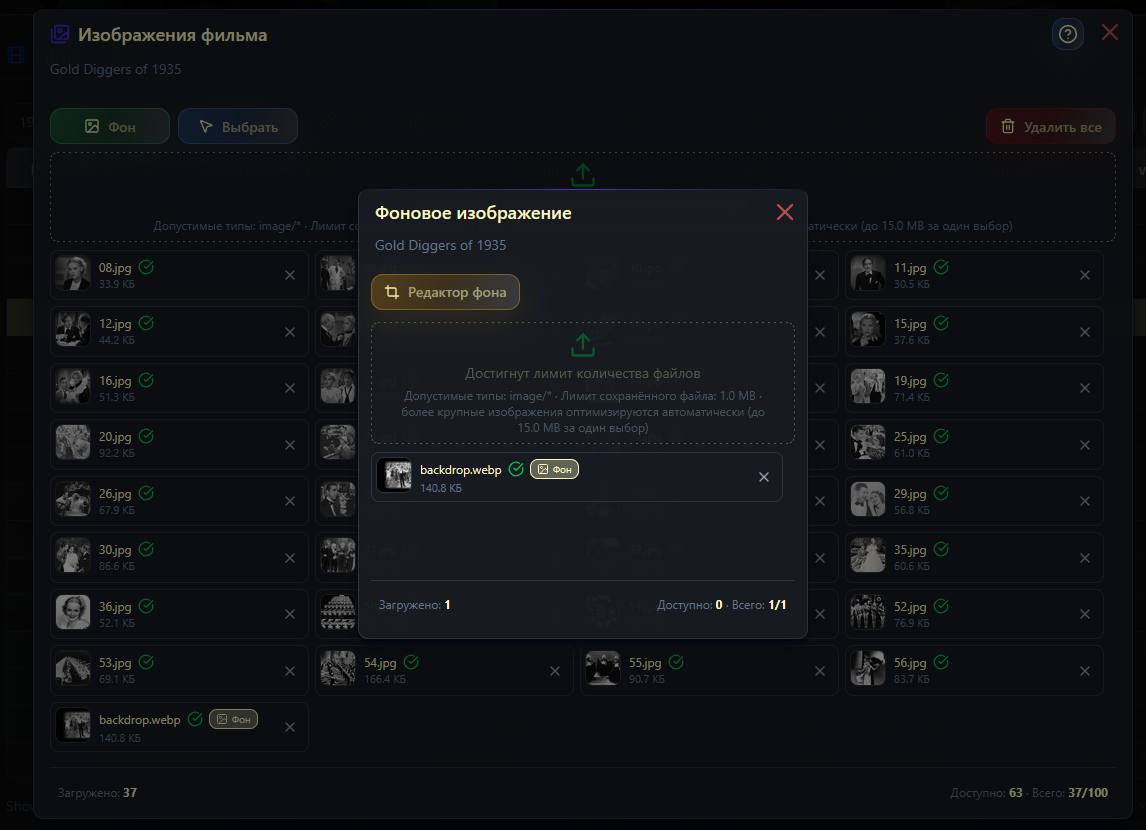
Load a frame from your computer, position it on a solid background, and adjust its size. The image keeps its proportions, you can choose the background color, and soft edges help blend the frame into the composition. A preview with guides for the poster, title, and menu lets you assess the result before saving. The finished backdrop is saved as a 1920 × 1080 WebP image up to 1 MB.
To open the tool, go to the film's images in Collection Manager, click Backdrop, then Backdrop editor. The screenshot below shows both buttons in the Russian interface («Фон» and «Редактор фона»); click the image to view it at full size.
08.11.2026
New film essay: The flowering of silent Hollywood
A new illustrated essay, The flowering of silent Hollywood, explores American silent cinema from 1920 to 1928. The selection reveals the variety of the era, from the comedies of Chaplin, Keaton and Lloyd and the adventures of Fairbanks to Sunrise, Greed, The Crowd and The Phantom of the Opera.
Dedicated sections introduce actors and actresses whose screen images helped define this cinema. Posters, characters and film frames in the collection screenshots can be viewed at full size. The essay is available in English and Russian, and the film essay catalogue now includes an American cinema category.
07.11.2026
A second film essay: cinema of the Weimar Republic
A new illustrated essay is available in Film essays: Weimar cinema: beyond expressionism. It continues our exploration of German cinema of the 1920s and early 1930s, from the two parts of Die Nibelungen to M, through psychological drama, mountain adventure, science fiction and everyday life in Berlin.
The essay brings together nine films and dedicated sections on Georg Wilhelm Pabst, Emil Jannings and Louise Brooks. Collection screenshots let you explore posters, character portraits and film stills at full size. The film essay catalog now offers filters by country and decade.
We plan to keep developing the section with new essays on national cinemas, directors and actors, exploring unexpected connections between films. The material gathered in a collection becomes a starting point for new stories about cinema.
06.11.2026
New guide: how to choose a movie catalog app
The Guides section now includes How to choose a movie catalog app for your collection. It helps you identify the features you need: adding film data, working with characters, creating themed selections and exploring your collection.
Examples and screenshots from a Star Wars collection show how these tasks work in flickollect. A separate section covers gathering material for reviews, video essays and film research.
Film essays: a new section and its first illustrated essay
The website now has a Film essays section with illustrated explorations of films, people and movements in cinema history. You can find it in the site footer.
The first essay, German Expressionist Cinema, brings together seven films from The Cabinet of Dr. Caligari to Metropolis, along with a short section on Fritz Lang, Friedrich Wilhelm Murnau and Rudolf Klein-Rogge’s screen characters. Posters, characters and film stills shown in the collection screenshots can be explored in full screen.